

Abstract
Cardence.io emerged during the 2021 crypto bull market as a pioneering Initial DEX Offering (IDO) platform tailored for the Cardano (ADA) network. However, due to technological dependencies and shifting market dynamics, its native token ($CRDN) experienced a near-total price collapse. By repurposing the digital ruins of Web3 launchpads into analytical lenses, we conduct a post-mortem on the Cardence lifecycle to illuminate the stark contrasts between the nature of decentralized finance (DeFi) in 2021 and 2026. We draw on regulatory developments (EU’s MiCA, UK’s evolving framework) and market analyses (Chainalysis, B2Broker) to show how token economics and launchpad design must now emphasize audited code and sustainable fundamentals. Cardence’s story becomes a lens through which to understand today’s stringent standards for blockchain projects.
Introduction
In 2021, the digital landscape was a frontier of boundless optimism. Retail capital flowed freely into emerging Layer-1 and Layer-2 protocols, and the promise of decentralized finance (DeFi) seemed capable of disrupting traditional banking structures overnight. Cardence.io was born into that era, specifically designed to launch the next generation of Web3 decentralized applications (DApps) on the Cardano blockchain.
But like many early blockchain pioneers, the original vision met the harsh reality of market cycles, technical hurdles, and shifting ecosystem tides. Designed as a premier incubator for the Cardano ecosystem, the platform eventually fell dormant.
This report utilizes Cardence as a case study to help Web3 participants navigate the highly complex 2026 landscape, demonstrating how strict new rules, proper planning, and verifiable transparency have completely rewritten the operational requirements for blockchain projects in 2026.
Cardence’s Architecture and Ambitions
To understand the architectural ambitions behind Cardence, it is necessary to examine the macroeconomic and technological landscape at the time of its creation. During the height of the 2021 cryptocurrency bull market, the Ethereum network was widely recognised as the dominant platform for smart contracts and decentralised finance. Much of the rapidly expanding Decentralized Finance (DeFi) ecosystem, including lending protocols, decentralised exchanges, and token launches, was built on Ethereum’s infrastructure.
However, by that stage, the network faced growing structural challenges. High demand pushed gas fees to extreme levels, while network congestion slowed transaction speeds. For retail investors and developers alike, these issues significantly raised the cost of interacting with DeFi protocols.
Market participants and developers desperately sought Layer-1 alternatives. While Binance Smart Chain (BSC) solved some throughput concerns, its alignment towards centralization made it an odd fit in a fundamentally decentralized space. Consequently, Cardano was widely acknowledged as a promising project, possessing clear advantages in terms of scalability by design.
Developed by Charles Hoskinson and the blockchain research company Input Output Global, Cardano acted as a scientifically grounded blockchain platform that emphasised peer-reviewed research, security, and scalability through its proof-of-stake consensus mechanism. Cardence positioned itself as a Cardano-based launchpad, leveraging Cardano’s reputation for security, scalability, and academic rigor to attract innovative DeFi, GameFi, and NFT projects.
To attract capital and high-quality start-ups, Cardence aimed to solve the common issues of early crypto fundraising. It promised secure presales by replacing risky manual payments with fully automated smart contracts. Furthermore, the platform sought to prevent scams by requiring project owners to lock a set percentage of their raised funds before they could access the remainder. It also introduced strict rules to stop sudden market crashes by staggering the release of tokens for both buyers and the project team when launching on a decentralised exchange.
Why Cardence Never Reached Cardano: Delays, Developer Barriers, and Market Timing
Despite its identity as a Cardano-focused multichain launchpad, Cardence launched initially on Binance Smart Chain and never successfully deployed on the Cardano mainnet, which ultimately undermined its core mission.
Cardence was built in anticipation of Cardano’s smart contract rollout, known as the Plutus Platform. At the time of Cardence’s inception, Cardano was not yet smart contract-enabled. The platform’s roadmap necessitated deploying initial features (like the Token Locker and Fixed Swap DEX) on the Binance Smart Chain (BSC), with a planned migration to the Cardano Mainnet later.
However, Plutus and its underlying programming language, Haskell, were not established within the broader Web3 developer community. When technical complexities delayed the realization of Cardano’s DeFi capabilities, Cardence was left as an accelerator without an active ecosystem to accelerate. By the time the underlying infrastructure matured, the broader cryptocurrency market had already begun its descent into a multi-year bear market. Capital migrated to faster, immediately operational alternative chains (such as Solana and Avalanche), leaving Cardano-native platforms starved of the volume necessary to sustain their economies.

Cardence’s homepage, May 2021
Why the $CRDN Token Crashed: Staking Incentives, Emissions, and Platform Decline
The collapse of the native token of Cardence, known as CRDN, illustrates the structural vulnerability of utility tokens that lack sustained platform activity and revenue generation. Like many early launchpad tokens across the broader Decentralized Finance (DeFi) sector, CRDN’s value proposition depended heavily on staking incentives and access privileges rather than on recurring economic output from the underlying platform.
To participate in guaranteed presale allocations, users had to hold and stake a minimum of 1,000 tokens. The platform utilized a complex “Token Weight Score” to determine allocation sizes, heavily incentivizing long-term lock-ups. For instance, staking in a 30-day lock pool provided a 4x multiplier compared to a no-lock pool’s 1x multiplier. The mathematical formula for allocation dictated that a participant’s share was relative to their Pool Weight Score divided by the Sum of all pool weight scores, multiplied by the tokens for sale.
Initially, with a total supply of 50 million tokens and an initial circulating supply of only 11.75 million, scarcity drove the price. However, as the delays in the Cardano mainnet persisted, the promised IDOs failed to materialize in sufficient volume. Without new projects launching, the primary utility of the $CRDN token, access to exclusive presales, evaporated.
This triggered a devastating reflexive loop. As the price began to slide, the cost to acquire the 1,000 tokens needed for the “guaranteed participation” tier plummeted, diluting the perceived exclusivity of the platform. Furthermore, high token emissions designed to bootstrap liquidity (such as the 8 million tokens reserved for liquidity mining) inflated the supply while demand crashed. Unlocked stakeholders, including those from the public and private sales (who were subject to vesting releases of up to 20% every 30 days), rushed for the exits, overwhelming the automated market maker (AMM) liquidity pools.
Ultimately, the roughly 99% decline in CRDN’s value was not the result of a single failure but the cumulative outcome of declining platform activity, increasing token supply, and weakening investor incentives. In economic terms, the collapse demonstrated how algorithmic tokenomics alone cannot sustain a digital asset when the underlying platform fails to generate consistent ecosystem growth.
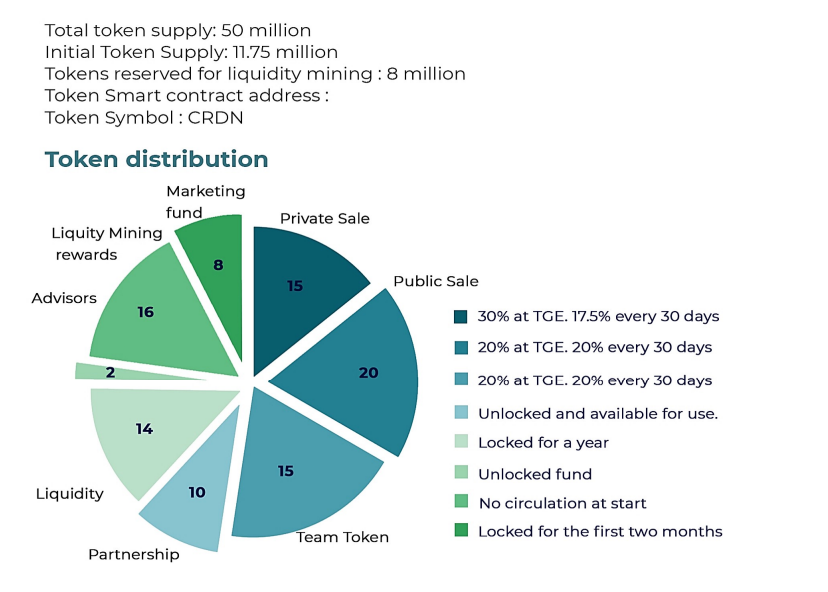
Cardence (CRDN) Tokenomics, from the 2021 whitepaper.
The 2026 Crypto Landscape: Institutional Capital and Verifiable Transparency
When examining the ruins of 2021 through the lens of 2026, the contrast in market structure is striking. The retail investors who once eagerly bought into Web3 launchpad ecosystems in hopes of exponential, speculative returns have largely altered their behavior or exited the market entirely.
Capital is no longer allocated based solely on ambitious whitepapers and community Telegram channels. Modern blockchain integration is dominated by institutional entities, algorithmic trading firms, and regulated asset managers. This paradigm shift demands stringent due diligence, fully audited open-source smart contracts, and tangible, sustainable revenue models.
Today, a platform cannot simply promise to lock team tokens manually or via basic smart contracts. The 2026 market demands cryptographic proofs of reserves, real-time on-chain transparency, and compliance with global regulatory frameworks. Europe exemplifies this trend. Chainalysis reports that between 2023 and 2025, regional transaction volumes reached new heights, specifically peaking at $234 billion in December 2024. Even smaller markets have grown to rival older leaders like the UK and Germany, indicating robust network effects.
The EU’s Markets in Crypto-Assets (MiCA) came into force in 2024, creating the first pan-European crypto rulebook. MiCA standardizes issuer and exchange requirements, and imposes strict rules on tokens (particularly stablecoins, which are now classed as either Asset-Referenced Tokens or E-Money Tokens). In practice, that means issuers must have full authorizations, high-quality reserves, and continuous disclosures. Similarly, the UK is finalizing its own crypto regulations (under the FSMA 2000 framework) and already treats stablecoins and crypto services as regulated finance.
Lessons Learned and Best Practices for 2026 Projects
The Cardence case provides actionable guidance for today’s crypto innovators:
- Strong Governance and Risk Controls: Both institutional and retail investors expect familiar safeguards. Projects should employ multi-sig custodial wallets, insurance for hacks (via on-chain solutions or firms like Nexus Mutual), and clear contingency plans. They should also enforce token vesting in smart contracts (so that team allocations unlock predictably) and implement slashing or stake-lock mechanisms if needed. In effect, a 2026 crypto launchpad needs an enterprise-grade treasury system, not a black box.
- Robust Tokenomics: Token incentives must be balanced with real economic activity. Early-stage rewards (liquidity mining, staking yields) should not outpace the platform’s ability to absorb that issuance. Best practices include making inflationary reward schedules transparent and limited, and aligning token utility with actual platform usage (e.g. governance voting power for stakers, fee-sharing with token holders). The $CRDN crash shows that heavy emissions without active demand lead to collapse.
- Focus on Sustainable Growth: By demonstrating clear revenue paths (such as platform fees or service subscriptions), a crypto project can attract the long-term capital that now dominates the market. As B2Broker notes, “24/7 market accessibility” and diversified yield structures are key drivers for institutions. Examples include integrating with regulated counterparties, partnering with established DeFi protocols, or developing real-world use-cases (e.g., tokenizing private assets).
- Regulatory Alignment: Any token or service should be structured with compliance in mind. This means understanding MiCA categories (for tokens) and applying for MiCA/CASP authorization where needed. For example, the FCA’s “crypto sandbox” initiative suggests firms should prepare for auditing, compliance frameworks, and eventually full FCA registration
- Institutional-Grade Transparency: Platforms should publish open-source code and undergo professional audits. Auditors like CertiK or Trail of Bits are expected in the EU/UK market. Liquidity pools and treasuries must be clearly documented on-chain (e.g. merkleized proofs of reserve). Regulators increasingly view proof-of-reserves as a necessary transparency tool.
Conclusion: From Launchpad to Lens
Recognizing this profound paradigm shift, we have acquired Cardence.io as an exercise in applied financial journalism and digital archaeology. We do not just review centralized exchanges (CEXs) and DEXs; we perform rigorous post-mortems on market mechanics and audit the transparency of the modern trading world.
By dissecting why systems like Cardence’s guaranteed participation algorithms and auto-locked liquidity failed to protect investors from a total drawdown, we can better evaluate the risk-management protocols of modern decentralized finance applications. The digital asset ecosystem of 2026 requires tools for survival, not promises of the moon. Transparency is no longer a marketing buzzword; it is an institutional prerequisite.
The story of Cardence is the standard lifecycle of a first-generation pioneer operating ahead of its foundational infrastructure. By preserving and analyzing its history, we transform a monument of failure into an indispensable tool for future navigation. In the modern financial world, the most valuable asset is the unvarnished truth about market mechanics. Cardence is no longer a launchpad. It is a lens.
References & Works Cited
- Cardence. (2021). CARDENCE: The first IDO platform for Cardano – Whitepaper.
(https://web.archive.org/web/20210530213314/https://cardencex.io/Whitepaper_cardence.pdf)
- FCA. Stablecoin payments a priority for 2026 as FCA outlines growth achievements. FCA Press Release, Feb 2026
- KYC Chain. “Stablecoins Regulations in 2026: USDT vs USDC Compliance, MiCA Market Access, and Listing Risk.” KYC-Chain Blog, Mar 5, 2026.
- B2Broker. “Institutional Adoption of Cryptocurrency: 2025-2026 Market Analysis.” Nov 2025.
- Fidelity Digital Assets. Navigating Digital Assets Market Structure in the UK and Europe. Jan 2026.
- Chainalysis. “European Crypto Adoption Highlights a Patchwork of Convergence and Transformation.” Oct 2025.
- Soros, George (2003). The Alchemy of Finance. Wiley. (Concept of reflexivity in markets).
- Nakamoto, Satoshi (2008). Bitcoin: A Peer-to-Peer Electronic Cash System. (Foundation of trustless verification).
- Voshmgir, Shermin (2020). Token Economy: How the Web3 reinvents the Internet. Token Kitchen. (Insights on token supply mechanics).
- Chainalysis. 2025 Geography of Cryptocurrency Report. (Data on transaction volumes and adoption in Europe).
- General Cryptocurrency Market Data (2021-2026). Historical volume and pricing metrics reflecting the macroeconomic shift from retail-driven Initial DEX Offerings to institutional decentralized finance adoption.