
Proof of Reserves vs. Proof of Trust: Ranking Exchange Transparency in the Post-FTX Era
March 13, 2026Abstract
The catastrophic failures of major cryptocurrency platforms in recent years exposed the systemic dangers of applying traditional Fractional Reserve Banking practices to digital asset custodianship. In response, the industry has fractured into two distinct transparency models: Proof of Reserves (PoR), a cryptographic method verifying on-chain assets, and Proof of Trust, a holistic measure of regulatory compliance, corporate governance, and traditional auditing. This paper analyzes these mechanisms, evaluating how metrics like the Collateralization Ratio and Trust Score impact user safety. Incorporating recent peer-reviewed insights and analyzing the current 2026 regulatory environment in the UK (FCA) and Europe (MiCA), we propose that true exchange Solvency requires a hybrid approach. Through detailed case studies of FTX, Binance, and Kraken, this research demonstrates that combining cryptographic privacy tech, such as Zero-Knowledge Proofs (zk-SNARKs), with strict institutional oversight is the only viable path forward for Custodial crypto platforms.
The Shift from Blind Trust to Cryptographic Proof
The rapid expansion of the global cryptocurrency market has deepened our reliance on top-tier centralized exchanges—such as Binance, Coinbase, Kraken, OKX, and KuCoin. Operating largely as Custodial entities, these platforms control billions of pounds and euros in user funds. For years, the industry operated on an implicit, reputation-based trust model. However, the catastrophic 2022 collapse of FTX shattered the illusion that reputation and a high Trust Score alone could guarantee safety. It became glaringly obvious that when an exchange operates opaquely, users bear the ultimate risk.
This crisis accelerated the demand for verifiable transparency. Today, users and regulators alike demand mathematical proof that an exchange’s On-Chain Data strictly aligns with its user deposits. Simultaneously, European and UK regulators have radically transformed the legal landscape. The EU’s Markets in Crypto-Assets Regulation (MiCA), fully applicable as of late 2024 with its final transition periods concluding in 2026, has created the world’s first comprehensive regulatory regime for crypto. Meanwhile, the UK’s Financial Conduct Authority (FCA) has integrated cryptoassets into the Financial Services and Markets Act (FSMA), enforcing stringent safeguarding rules that mirror traditional finance.
In this paper, we examine the technical and qualitative methods used to rank exchange transparency, analyzing how the collision of cryptographic innovation and European regulatory frameworks is creating a new standard for digital finance.
Defining the Pillars of Transparency
To rank exchange transparency effectively, we must first understand the two primary methodologies platforms use to prove their legitimacy: the technical (Proof of Reserves) and the qualitative (Proof of Trust).
Proof of Reserves (PoR)
Proof of Reserves is a cryptographic accounting standard. It allows a Cryptocurrency Exchange to publicly prove it holds enough digital assets to cover all user balances without revealing sensitive individual account data or proprietary wallet architectures.
The standard PoR protocol relies heavily on a Merkle Tree (or Hash Tree) data structure.
Here is how the standard mechanism works:
- Hashing Balances: The exchange hashes individual user account balances.
- Aggregation: These hashes are paired and hashed together repeatedly, moving up the “tree.”
- The Root: The final, single hash at the top of the tree is the Merkle Root, which summarizes the entire dataset of user liabilities and is published publicly.
- User Verification: Users can input their unique cryptographic hash into the exchange’s portal (or a third-party open-source tool) to verify their funds were included in the snapshot that generated the Merkle Root.
Recent academic literature (e.g., Journal of Cryptographic Engineering, 2025) emphasizes that standard Merkle Tree PoR is fundamentally insufficient on its own. Researchers point out that standard PoR only proves assets, not the full scope of what an exchange owes (Liabilities). To solve this, advanced exchanges are now adopting Zero-Knowledge Proofs (zk-SNARKs). This cryptography allows an exchange to mathematically prove its solvency and liability coverage without exposing its client list or internal mechanics to competitors or malicious actors.
Proof of Trust
While PoR is deeply technical, Proof of Trust is holistic. It measures the qualitative signals of an exchange’s reliability. Data aggregators and rating agencies often quantify this via a Trust Score, evaluating variables such as:
- Auditing: Regular financial inspections by recognized entities (e.g., the Big Four accounting firms or specialized blockchain security firms like Hacken and CertiK).
- Security Infrastructure: The ratio of funds kept in highly secure, offline Cold Storage versus operational, internet-connected Hot Wallets.
- Market Health: The platform’s overall Liquidity and spread tightness, which dictate how easily users can exit their positions during market panic.
- Regulatory Compliance: Active engagement and licensing with authorities like the UK FCA, EU regulatory bodies, or the US SEC and CFTC.
Evaluating Solvency: The Mathematics of Transparency
The ultimate goal of demanding exchange transparency is proving Solvency—the ability of an exchange to meet its long-term financial obligations. The fundamental requirement for a custodial exchange is to maintain a 1:1 (or greater) backing of user funds. Formally, an exchange achieves baseline solvency when total verifiable assets exceed or equal total cryptographic liabilities:
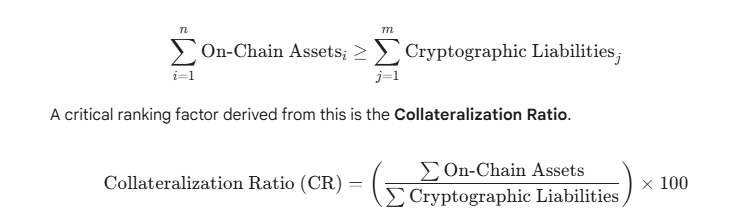
If an exchange holds £1.2 billion in assets but owes £1 billion to its users, its ratio is 120%, indicating a healthy surplus. If the ratio dips below 100%, the exchange is technically insolvent and is dangerously operating under a fractional reserve model.
Case Studies: Transparency Models in Action
To understand the practical application and failures of these transparency models, we must examine real-world case studies that define the modern crypto landscape.
Case Study 1: The Ultimate Failure of Proof of Trust – FTX
In early 2022, FTX was widely considered one of the safest exchanges in the world. It boasted high Trust Scores on major aggregation sites, extensive Liquidity, a charismatic CEO heavily involved in regulatory lobbying, and backing from top-tier venture capital firms. It relied entirely on a Proof of Trust model.
However, behind the scenes, FTX was secretly transferring user deposits to its sister trading firm, Alameda Research. Because FTX was highly opaque and did not utilize On-Chain Data or Proof of Reserves, the public could not verify its Collateralization Ratio. When a liquidity crisis hit in November 2022, the exchange had massive Liabilities but almost zero liquid assets to cover them. The FTX collapse is the seminal event that proved qualitative “trust” is easily fabricated in the digital asset space.
Case Study 2: Binance’s Evolution to zk-SNARKs
Following the FTX collapse, Binance (the world’s largest exchange by volume) faced immense pressure to prove its solvency. Initially, Binance published a standard Merkle Tree PoR and engaged the auditing firm Mazars to verify its Bitcoin reserves. However, in a blow to the Proof of Trust model, Mazars abruptly paused all crypto auditing work shortly after, citing concerns over how the public misunderstood their limited reports as full financial audits.
Realizing that traditional auditing firms were hesitant to underwrite crypto risk, and that standard Merkle Trees couldn’t guarantee negative balances weren’t being hidden, Binance pivoted. They integrated Zero-Knowledge Proofs (zk-SNARKs) into their PoR system. This allowed them to cryptographically prove that no user accounts had negative balances (which could artificially reduce the total liability count) while maintaining user privacy. This case study highlights the industry’s shift from relying on third-party auditors (Proof of Trust) to relying on immutable mathematics (Advanced PoR).
Case Study 3: Kraken and the Hybrid Model in Europe
Kraken provides an excellent example of the hybrid model currently favored by UK and European regulators. Kraken was one of the earliest adopters of cryptographic Proof of Reserves, conducting independent, cryptographically verifiable audits well before it became an industry standard.
However, Kraken also heavily invests in Proof of Trust. To operate smoothly under MiCA in Europe and the FCA in the UK, Kraken maintains traditional banking licenses where applicable, undergoes rigorous cybersecurity audits by firms like Armanino (historically), and strictly separates client funds from corporate operational funds. By combining the cryptographic certainty of PoR with the institutional compliance required by European law, Kraken represents the gold standard for Custodial exchange transparency in 2026.
Architectural Differences: Custodial vs. Non-Custodial Platforms
The relevance of these transparency models shifts dramatically depending on the underlying architecture of the trading platform.
Centralized Exchanges (CEXs)
Because platforms like Crypto.com and OKX are custodial, the risk of “accountability voids”—a term highlighted in 2025 financial governance research out of the London School of Economics—is severe. Users must rely on a combination of PoR and Proof of Trust to ensure their funds aren’t being secretly lent out. For CEXs, the implementation of zk-SNARK PoR is no longer optional; it is a baseline competitive requirement.
Decentralized Exchanges (DEXs)
Non-custodial platforms like Uniswap or heavily decentralized liquid staking protocols operate on a fundamentally different paradigm. Users retain control of their private keys, and trades execute automatically via publicly verifiable Smart Contracts.
Here, traditional PoR is redundant because the platform’s solvency is inherently transparent. However, the risk merely shifts. Instead of worrying about corporate fraud or fractional reserve banking, DEX users must evaluate other risks. An example is Cardence, which primarily relied on a security audit by CertiK. Despite this technical oversight and its decentralized launchpad model, the project effectively collapsed due to a combination of market illiquidity, diminishing utility, and additional issues. The collapse illustrates that even “secure” or “audited” decentralized protocols can fail if they lack sustained community engagement, consistent development, or a robust economic model to withstand prolonged bear market conditions
The Regulatory Future: The UK and Europe Lead the Way
In the post-FTX landscape, European authorities recognized that relying on voluntary cryptographic proofs was insufficient. The market has rapidly transitioned from a self-regulated “Wild West” to a structured financial ecosystem.
The MiCA Framework (European Union)
By 2026, the Markets in Crypto-Assets Regulation (MiCA) has fundamentally reshaped the European crypto landscape. MiCA enforces strict capital requirements, mandating that stablecoin issuers and Crypto-Asset Service Providers (CASPs) maintain robust, unencumbered reserves.
Crucially, MiCA aims to eliminate subjective trust by legally enforcing transparent reporting. Exchanges operating in the EU can no longer simply claim their funds are safe in Cold Storage; they must undergo mandatory, standardized disclosures that are heavily scrutinized by national competent authorities.
Also Read: The Launchpad Illusion: Why “Vetted” Projects Often Fail
FCA Regulations (United Kingdom)
Following the EU’s lead, the UK has aggressively positioned itself as a regulated crypto hub. The Financial Services and Markets Act (FSMA) has been expanded to treat cryptoasset safeguarding similarly to traditional client funds (CASS rules).
The FCA now requires extensive disclosures regarding risk, liability management, and operational resilience. For an exchange to market itself to UK consumers in 2026, it must navigate a stringent regulatory gateway. The FCA effectively mandates a Proof of Trust model—requiring physical presence, approved persons in leadership, and traditional audits—while highly encouraging the supplementary use of PoR technologies to provide real-time assurance to retail investors.
Comparing Transparency Models: A Synthesis
The following table summarizes the strengths and weaknesses of the two primary models used to rank exchange transparency today.
| Feature | Proof of Reserves (PoR) | Proof of Trust |
|---|---|---|
| Core Mechanism | Cryptography (Merkle Trees, zk-SNARKs) | Financial Audits, Governance, Security history |
| Primary Strength | Mathematically verifiable; immune to human bias and corporate deception. | Covers off-chain risks, corporate health, and legal compliance. |
| Primary Weakness | It is only a snapshot in time; historically, it struggles to verify total hidden Liabilities. | Highly subjective; a strong reputation can mask deep insolvency. |
| Best Application | Verifying real-time on-chain asset backing for retail investors. | Assessing long-term operational viability and regulatory standing. |
Conclusion
Transparency has become the defining challenge of the cryptocurrency industry. Peer-reviewed literature and recent market events confirm that relying on a single methodology to rank exchange transparency is fundamentally flawed.
Proof of Reserves provides a necessary, trustless technical solution, allowing users to verify asset backing through cryptographic methods. Yet, as academics point out, without concurrent Proof of Liabilities and real-time monitoring, PoR remains an incomplete safeguard vulnerable to snapshot manipulation. Conversely, Proof of Trust failed spectacularly during the 2022 market crashes, proving that traditional audits struggle to keep pace with the speed and opacity of digital asset movements.
The ultimate standard for ranking exchange transparency in 2026 is a tightly integrated hybrid model. As the UK FCA and European MiCA enforce stringent new regulations, the safest and highest-ranking platforms will be those that pair real-time, zero-knowledge cryptographic solvency proofs with rigorous, traditional institutional oversight. By combining regulatory supervision with immutable mathematics, the industry can finally move beyond blind trust and offer the verifiable financial security users deserve.
References & Further Reading
Regulatory Frameworks & Official Guidance
- European Securities and Markets Authority (ESMA). (2024–2026). Markets in Crypto-Assets Regulation (MiCA). Official guidelines on the implementation of MiCA, transitional periods, and capital requirements for Crypto-Asset Service Providers (CASPs). View Official ESMA MiCA Hub
- UK Financial Conduct Authority (FCA). (2026). A new regime for cryptoasset regulation. Official roadmap detailing the Financial Services and Markets Act 2000 (Cryptoassets) Regulations 2026, including the authorization gateway and safeguarding rules. View Official FCA Crypto Regime
Peer-Reviewed Literature & Academic Research
- Conley, T., et al. (2023/2024). Instant Zero Knowledge Proof of Reserve. Cryptology ePrint Archive. Evaluates the implementation of high-throughput, non-interactive zk-SNARKs for proving financial assets without compromising user anonymity. Read the Paper on IACR
- Ferreira, A., et al. (2024). Centralised Exchanges & Proof-of-Solvency: The Guardians of Trust. ResearchGate. An empirical analysis of proof-of-assets using data disclosed by leading centralized exchanges, evaluating resilience during the 2022 market crashes. Read the Study on ResearchGate
- Liu, Z., et al. (2023). Private Proof of Solvency. arXiv. Discusses the cryptographic commitments required to demonstrate the existence and integrity of exchange liabilities using Merkle Trees and Zero-Knowledge Proofs. Read the Paper on arXiv
Industry & Technical Blueprints
- Buterin, Vitalik. (November 2022). Having a safe CEX: proof of solvency and beyond. The foundational article proposing the industry-wide shift from basic Merkle Trees to zk-SNARKs to guarantee that exchanges cannot hide negative balances or undisclosed liabilities. Read Vitalik’s Blueprint
- PwC. (2023/2024). Does «Proof of Reserves» provide meaningful trust and transparency? An auditor’s perspective on the limitations of cryptographic snapshots versus holistic financial statement audits (Proof of Trust). Read PwC’s Insights